How Does PPC Work? The Complete Beginner’s Guide to Pay-Per-Click Advertising [2026]
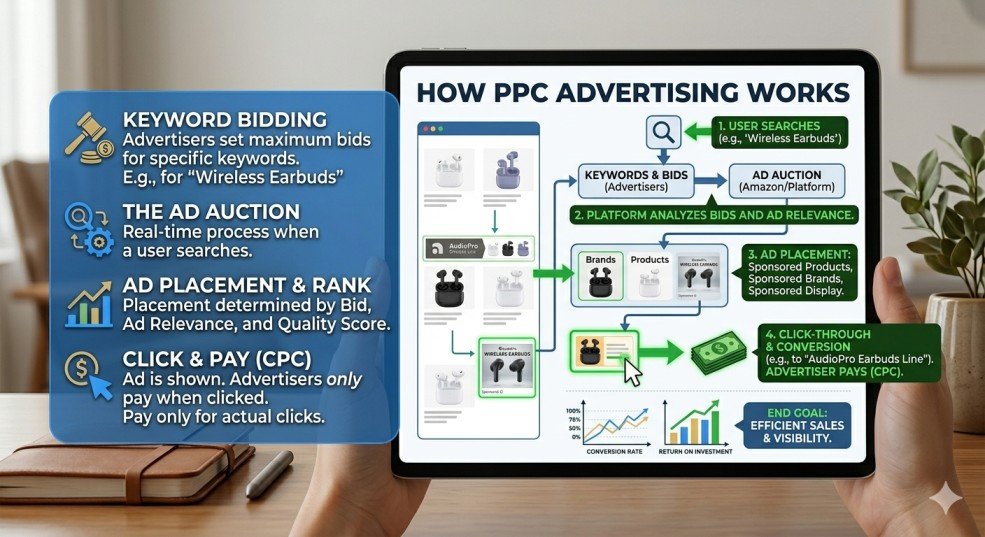
PPC stands for Pay-Per-Click. It is an online advertising model where you, the advertiser, pay a fee each time someone clicks on your ad. Think of it as buying visits to your website, rather than earning them organically through SEO.
When you search for something on Google, the results at the very top—the ones that say “Ad” next to them—are PPC ads. Businesses pay to be there because they know people searching for their products or services are ready to buy.
Here is a simple example. Imagine you run a travel agency in Dubai offering desert safaris. You create a Google ad for the keyword “desert safari Dubai.” When someone searches for that term, your ad appears. If they click on it, you pay a small fee. If nobody clicks, you pay nothing. That is the beauty of the model—you only pay for results.
This advertising model is also known as paid search or search engine marketing (SEM) . It is one of the most effective ways to get your business in front of customers who are actively looking for what you offer.
How Does the PPC Auction Actually Work?
Many people think PPC is simply about having the biggest budget. That is a myth. The system behind it is smarter than that.
Every time someone types a search query into Google, an instant ad auction happens behind the scenes . This takes place every single time someone searches on Google, and it happens in a fraction of a second—often in milliseconds .
During this auction, Google looks at all the ads that could match the search and decides which ones to show. It does not simply pick the highest bidder. It picks the ad that provides the best experience for the user. This is a key principle: the auction uses Ad Rank to determine your ad’s eligibility and, if eligible, its position .
Step-by-Step: What Happens in the Auction
Google explains the auction process in six steps :
- The search: Someone types a query into Google (like “pizza delivery” or “desert safari Dubai”) .
- Ads are narrowed down: The Google Ads system finds all ads whose keywords match that phrase closely enough. It then ignores any ads that are not eligible (e.g., ads targeting a different country or that are disapproved) .
- Ads are removed: The system determines which ads have a sufficiently high Ad Rank to show. Ads that do not exceed the minimum quality standards necessary to show are removed .
- Ads are ordered: The remaining ads are shown, ordered on the page based on Ad Rank .
- Ads appear! The user sees relevant ads .
- Repeat the process: Every time someone does a search, the whole auction process starts again with potentially different results each time .
The Two Critical Factors That Determine Ad Position: Ad Rank
Your ad’s position on the search results page is determined by Ad Rank. The formula is powerful but not as simple as just “highest bidder wins.”
According to Google, the main components of Ad Rank are :
- Your bid amount
- The quality of your ads and landing page
- The Ad Rank thresholds
- The competitiveness of an auction
- The context of the person’s search
- The expected impact of assets and other ad formats
- Bidding (The Monetary Side)
This is the maximum amount you are willing to pay for a click. You can set this manually or use automated strategies. Manual bidding gives you full control over each keyword’s bid. Automated bidding (also called Smart Bidding) lets Google adjust your bids to get the best results for your goals.
Popular automated strategies include:
- Maximize Clicks: Gets you the most clicks for your budget.
- Target CPA: Aims to get conversions at a specific cost-per-acquisition.
- Target ROAS: Aims to achieve a specific return on ad spend.
- Maximize Conversions: Gets you the most conversions for your budget.
- Quality Score (The Relevance Side)
This is often more important than your bid. Quality Score is a diagnostic tool that gives you a sense of how well your ad quality compares to other advertisers . It is measured on a scale from 1 to 10 and is available at the keyword level .
A higher Quality Score means your ad and landing page are more relevant and useful to someone searching for your keyword, compared to other advertisers .
Quality Score is calculated based on the combined performance of three components :
- Expected click-through rate (CTR): The likelihood that your ad will be clicked when shown .
- Ad Relevance: How closely your ad matches the intent behind a user’s search .
- Landing page experience: How relevant and useful your landing page is to people who click your ad .
Each component is evaluated with a status of ‘Above average’, ‘Average’, or ‘Below average’ . If one of these components has a status of ‘Average’ or ‘Below average’, this may indicate an opportunity to make improvements .
Important: Quality Score isn’t a key performance indicator and shouldn’t be optimised or aggregated with the rest of your data. It’s a diagnostic tool to identify how ads that show for certain keywords affect the user experience .
Breaking Down the PPC Ecosystem: Key Terms You Must Know
To succeed with PPC, you need to understand the language. Here are the most important terms:
Keywords & Match Types
Keywords are the words or phrases you bid on. Match types control when your ad shows. There are four main match types:
- Broad Match: Your ad shows on searches related to your keyword. For example, “running shoes” could trigger your ad for “best running shoes” or “buy sneakers online.” This gives you the most reach but the least control.
- Phrase Match: Your ad shows on searches that include the meaning of your keyword as a phrase. For example, “buy running shoes” could trigger your ad for “buy running shoes online” but not for “running shoes buy.”
- Exact Match: Your ad shows on searches that are the same as your keyword or have the same meaning. For example, “running shoes” might also trigger your ad for “shoes for running.”
- Negative Keywords: This is crucial for saving money. These are terms you do not want your ad to show for. For example, if you sell luxury watches, you might add “cheap” as a negative keyword.
Cost Per Click (CPC)
CPC is the actual price you pay for a single click. This is influenced by your bid, your Quality Score, and the competition for the keyword.
Click-Through Rate (CTR)
CTR is the percentage of people who see your ad and click on it (Clicks ÷ Impressions). A high CTR signals to Google that your ad is relevant, which can improve your Quality Score.
Conversion Tracking
This is how you measure success. A “conversion” is a desired action, like a sale, a sign-up, or a phone call. Setting up conversion tracking is essential to see if your ad spend is generating a return. You do this by placing a small piece of code (called a conversion tag) on your website.
Return on Ad Spend (ROAS)
ROAS is the revenue generated for every dirham spent on advertising. It is calculated as: (Revenue from Ads ÷ Cost of Ads) × 100. A ROAS of 500% means you earned AED 5 for every AED 1 spent.
Cost Per Acquisition (CPA)
CPA is the average cost to acquire a single customer or lead. It is calculated as: Total Ad Spend ÷ Total Conversions. Lowering your CPA is a primary goal for many advertisers.
Impression Share
Impression share is the percentage of impressions your ads receive compared to the total available impressions they could have received. A low impression share often means you are missing out on potential traffic.
Ad Extensions
Ad extensions are additional pieces of information you can add to your ad. They make your ad larger and more informative, which can improve your Ad Rank. Common ad extensions include:
- Sitelink Extensions: Add extra links to specific pages on your site.
- Callout Extensions: Highlight key benefits or features.
- Structured Snippet Extensions: Show a list of product categories or services.
- Call Extensions: Display a phone number on your ad.
- Location Extensions: Show your business address and a map.
Campaign Structure
A well-structured Google Ads account follows this hierarchy:
Google Ads Account → Campaigns → Ad Groups → Keywords & Ads
- Campaign: The top level. You set your budget, location targeting, and bidding strategy here.
- Ad Group: A collection of related keywords and ads. For example, a “Men’s Running Shoes” ad group.
- Keywords & Ads: Individual keywords and the ads they trigger within the ad group.
How to Set Up a Google Ads Campaign (The 7-Step Process)
Starting a PPC campaign might seem overwhelming, but it follows a clear structure. Here is a step-by-step guide:
Step 1: Define Your Goals.
What do you want to achieve? Brand awareness, website traffic, or sales? Your goal dictates your settings and bidding strategy.
Step 2: Do Keyword Research.
Use tools like Google’s Keyword Planner to find relevant search terms with good search volume and manageable competition. In the UAE, consider local search terms like “property for rent in Dubai” or “best karak chai near me.”
Step 3: Structure Your Account.
Organise your keywords into themed Ad Groups within your Campaign.
Step 4: Write Effective Ad Copy.
Write clear, compelling ads that include your keywords. Use strong calls to action (CTA) like “Book Now,” “Shop Today,” or “Contact Us.”
Step 5: Set Your Budget and Bidding.
Decide on a Daily Budget and choose your Bidding Strategy. For beginners, “Maximize Clicks” is a good way to start driving traffic.
Step 6: Build a High-Quality Landing Page.
Ensure the page people land on is directly relevant to the ad they clicked. It must load quickly and make it easy to complete the desired action.
Step 7: Set Up Conversion Tracking.
This is the most critical step. Use the Google Ads tag to track what happens after a click. If you are not tracking conversions, you cannot measure your ROI.
PPC Platforms: Where Can You Run PPC Ads?
While Google is the market leader, it is not the only option. A smart strategy often involves using multiple platforms.
- Google Ads: The largest platform. Best for reaching people actively searching for products and services.
- Microsoft Ads (Bing): A great alternative with often lower competition and costs.
- Amazon Ads: Essential for e-commerce brands targeting users with purchase intent.
- Social Media PPC (Facebook, Instagram, LinkedIn, TikTok): Excellent for targeting based on demographics, interests, and behaviours.
- Specialised Platforms (Reddit, Quora): Powerful for reaching niche audiences interested in specific topics.
Choosing the Right Platform for Your UAE Business
In the UAE, Google Ads is essential for reaching customers actively searching. Facebook and Instagram are also highly popular in the UAE.
Fact 1: Digital ad spending in the UAE reached 4.16 billion dirhams in 2024, with search ads accounting for 1.198 billion dirhams, growing at 12.39% year-on-year . The average per capita digital ad spend in the UAE is 422 dirhams .
Proven PPC Strategies & Optimization Tips for Success
PPC is not a “set it and forget it” activity. To succeed, you must continuously optimise.
- Master Your Search Terms Report
This is your most powerful tool. It shows you the exact search queries that triggered your ads. Add high-performing terms as keywords and irrelevant ones as negative keywords. - A/B Test Everything
Test different headlines, descriptions, and CTAs to see what works best. Even small changes can have a significant impact on CTR and conversion rate. - Use Ad Extensions Religiously
They improve your Ad Rank, give users more information, and are essentially free real estate on the SERP. - Optimise Your Landing Pages
Test headlines, layouts, and CTAs. Ensure your page is mobile-friendly. A slow-loading landing page can kill your conversions. - Monitor Your Quality Score
Regularly check your Quality Score and work to improve its components . According to Google, if a component has a status of ‘Average’ or ‘Below average’, this may indicate an opportunity to make improvements . - Protect Against Click Fraud
Click fraud is a real concern in PPC. Click fraud rates in search campaigns typically range between 14% and 22% . Google’s built-in filters catch obvious patterns like duplicate clicks or known bots, but they often miss sophisticated tactics such as device spoofing, rotating IPs, or hyper-engaged returning users . For complete protection, consider dedicated click fraud prevention tools .
Understanding PPC Risks & Limitations (An Honest Perspective)
PPC is powerful, but it is not without its downsides.
Risk 1: Costs Can Add Up Quickly
If you are not careful, your ad spend can exceed your profits. This is especially true in highly competitive industries.
Risk 2: Requires Ongoing Management
PPC is not a “set it and forget it” activity. It requires continuous attention, analysis, and adjustment.
Risk 3: Click Fraud
Click fraud is when competitors or bots click on your ads to waste your budget. Global ad fraud losses are projected to exceed 172 billion US dollars annually by 2028 .
Risk 4: Results Stop When the Budget Stops
Unlike SEO, which can provide long-term traffic, PPC traffic stops the moment you stop paying.
Risk 5: Competition Can Drive Up CPCs
If your competitors start bidding aggressively on the same keywords, your CPC can rise significantly.
UAE PPC Market Insights (Local Context)
The UAE is one of the most digital-savvy markets in the Middle East.
UAE Digital Ad Spend
Digital advertising spending in the UAE reached 4.16 billion dirhams in 2024, growing at 7.8% year-on-year . Search ads account for 28.79% of this spending, reaching 1.198 billion dirhams with a growth rate of 12.39% .
Average CPCs in the UAE
While costs vary widely by industry, here are general estimates:
| Industry | Average CPC (AED) |
| Travel & Tourism | 3 – 6 |
| Real Estate | 15 – 25+ |
| Education | 8 – 15 |
| Retail & E-commerce | 2 – 8 |
| Finance & Banking | 10 – 20 |
| Healthcare | 5 – 12 |
Cultural Considerations
- Use a professional, respectful tone in your ad copy.
- For a local audience, consider using Arabic or a mix of English and Arabic.
- Be mindful of cultural and religious sensitivities.
Popular Platforms in the UAE
- Google Ads: Essential for any serious business.
- Instagram: Extremely popular, particularly among younger demographics.
- Facebook: Widely used by expats and locals alike.
- TikTok: Rapidly growing in popularity.
- LinkedIn: Key for B2B marketing in the UAE’s growing professional services sector.
Frequently Asked Questions
What is PPC and how does it work?
PPC stands for Pay-Per-Click. It is a model where advertisers pay a fee each time their ad is clicked. It works through an instant auction where ads are ranked based on bid amount and the quality of the ad (Quality Score). The ad with the highest Ad Rank wins the top position .
How much does PPC cost?
The cost varies greatly by industry and keyword. In the UAE, Cost Per Click (CPC) on Google Search can range from AED 3 to AED 11 on average. Highly competitive sectors like real estate can see CPCs of AED 25 or more. If you’re looking for professional management to optimize your spend and reduce costs, consider PPC Management Abu Dhabi.
Is PPC better than SEO?
PPC offers immediate visibility, while SEO takes months to build. They are most powerful when used together. PPC is best for short-term goals, while SEO is best for long-term, sustainable growth. For businesses with a physical location, combining PPC with Local SEO Services Canada can be particularly effective.
What is a good Quality Score?
Quality Score is rated on a scale from 1 to 10 . A score of 7 or above is considered good and can significantly lower your costs. If a component has a status of ‘Average’ or ‘Below average’, this may indicate an opportunity to make improvements .
Do I need a big budget to start PPC?
Not necessarily. PPC is scalable. You can start with a daily budget as low as AED 50. The key is to focus on efficiency and ROI.
What is the difference between CPC and CPM?
CPC (Cost Per Click) is the cost you pay when a user clicks on your ad. CPM (Cost Per Mille) is the cost you pay for 1,000 impressions, regardless of clicks.
How can I measure success with PPC?
Success is measured through Conversion Tracking. This allows you to see which ads, keywords, and campaigns are generating the most leads or sales. Key metrics include Conversion Rate, CPA, and ROAS.
What are the main disadvantages of PPC?
The main disadvantages include high costs in competitive industries, the need for ongoing management, results stopping when the budget stops, and the potential for click fraud .
Can I do PPC for a local business?
Absolutely. Location targeting in Google Ads allows you to show your ads only to people in specific geographic areas—right down to a specific city or neighbourhood. Many businesses find that a combination of PPC and Local SEO Services Canada helps them dominate their local market.
What is click fraud and how can I protect against it?
Click fraud occurs when ads are clicked without genuine interest, often from bots, competitors, or click farms . Click fraud rates can range between 14% and 22% of clicks . Google’s built-in filters catch obvious patterns but may miss sophisticated tactics . Consider dedicated click fraud prevention tools for complete protection .
Conclusion: Getting Started with PPC
PPC is a powerful tool that can deliver immediate results and measurable ROI for businesses of all sizes in the UAE. It is a complex system, but the core principle is simple: place your ads in front of the right people at the right time, and you only pay for the engagement you get.
The journey to mastering PPC is a continuous process of learning, testing, and optimization. By understanding the mechanics of the auction, the importance of Quality Score, and the strategies for ongoing improvement, you can turn your ad spend into a powerful engine for business growth.
Whether you are a small business owner in Dubai, an entrepreneur in Abu Dhabi, or a marketing professional in Sharjah, PPC offers a direct path to reach your target audience and achieve your business goals in the competitive UAE market.
Ready to turn your PPC leads into revenue?
While this guide gives you the complete foundation, success with PPC requires more than just knowing how it works. You need a system to manage leads, nurture prospects, and convert clicks into customers. This is where having the right support makes all the difference.
For businesses in Abu Dhabi and the wider UAE, professional PPC Management Abu Dhabi can take the guesswork out of your campaigns, reduce wasted ad spend, and generate more qualified leads. Our team of Google Ads certified specialists handles everything from keyword research and ad copywriting to conversion tracking and monthly reporting—so you can focus on running your business while we turn your ad budget into a predictable lead engine. Book your free consultation today and discover how we can help you build a scalable, revenue-driven sales system for your business.
