
How to Do PPC in 2026: The Complete Walkthrough (From Setup to Advanced Optimization) for UAE Businesses
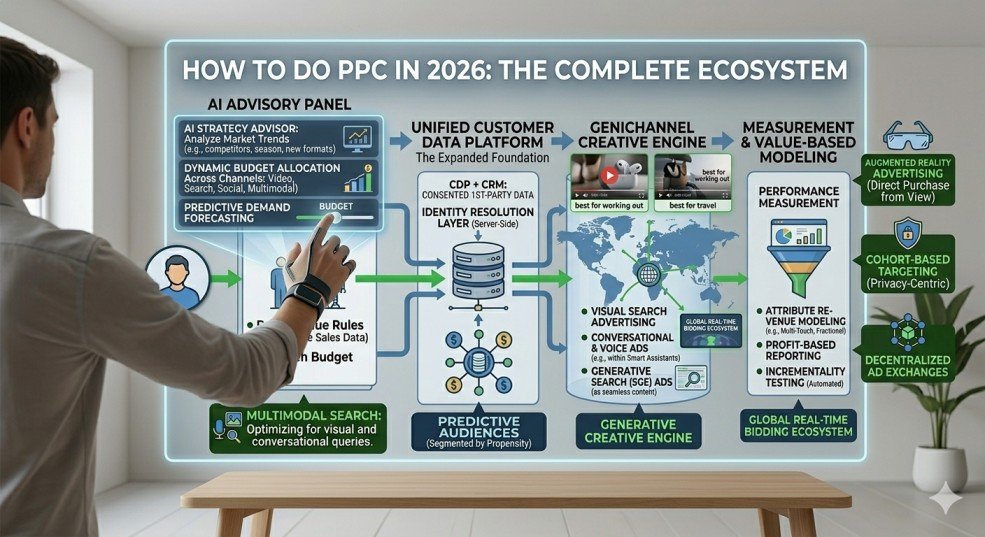
Introduction: Why PPC Matters More Than Ever in the UAE
Pay-per-click advertising is a digital marketing model where you pay a fee each time someone clicks on your ad. Instead of waiting months for organic SEO results, PPC gives your business instant visibility on search engines like Google.
Fact 1: The UAE has one of the world’s most digitally engaged markets, with social media usage near 100% penetration and residents spending hours online daily, making digital channels essential for brand reach and engagement .
Fact 2: The social commerce market in the UAE alone is projected to reach $3.8 billion by 2026, with platforms like Instagram Shops, TikTok Checkout, and WhatsApp Payments rapidly turning engagement into direct sales .
Fact 3: By 2026, paid social channels (Meta, TikTok, Snapchat) are expected to capture up to 58% of performance marketing budgets in the UAE as brands chase real ROI .
PPC puts your business directly in front of active buyers who are searching for what you offer. When someone in Dubai searches for “luxury apartments” or “best coffee shop Business Bay,” your ad can appear at the exact moment they’re ready to act.
What Users Really Want When They Search “How to Do PPC”
When users search for “how to do PPC,” they aren’t looking for a theoretical definition. They want a practical, step-by-step framework they can follow to set up their first campaign or improve their current efforts.
Most searchers share a common fear: wasting money. They’ve heard horror stories about burning through budgets with nothing to show for it. They want to know:
- Where do I start?
- How do I choose keywords?
- How much should I budget?
- How do I write ads that actually get clicks?
- How do I track if it’s working?
Your content must answer these questions directly, clearly, and actionably.
Step 1: The Pre-Setup Checklist (What to Do Before You Spend Anything)
Most PPC guides jump straight into account setup. This is a mistake. Before you log into Google Ads, you need to have your foundation ready.
Key Point: 90% of campaigns fail because advertisers skip this pre-launch phase.
Your Pre-Launch Checklist
- Define Your North Star Metric: What counts as success? Sales? Leads? App installs? Be specific.
- Calculate Your Break-Even CPA: How much can you afford to pay to acquire a customer without losing money?
- Build Your Landing Page First: You cannot send traffic to a page that doesn’t exist or isn’t optimised.
- Install Your Tracking Codes: Set up conversion tracking before launching any campaign.
Tip: Set up your Google Ads conversion tag and Google Analytics 4 (GA4) before you spend a single dirham. This ensures you capture data from day one. For expert assistance with your campaign setup, consider our professional PPC management services to ensure everything is configured correctly from the start.
Step 2: Set Up Conversion Tracking (The Non-Negotiable First Step)
Conversion tracking is the most critical element of any PPC campaign. Without it, you’re flying blind. A conversion in Google Ads is when a user performs a specified action after clicking an ad or viewing a Display Network ad, representing customer interactions vital to your advertising goals such as purchasing a product, installing a mobile app, or signing up for an email list .
Fact 4: You must enable conversion tracking in your Google Ads conversion account to record conversions. You can check your conversion tracking setup and status by querying the Customer resource for the ConversionTrackingSetting .
How to Set Up Conversion Tracking
- Create a Google Ads Conversion Action: Define what counts as a conversion (purchase, form submission, phone call, etc.). If the conversion_tracking_status value is NOT_CONVERSION_TRACKED, conversion tracking is not enabled for the account. Enable it by creating at least one ConversionAction .
- Install the Google Ads Conversion Tag: Add the global site tag and event snippet to your website. Enhanced conversions are enabled automatically when sent through the Google Ads API but can be disabled through the Google Ads UI .
- Use Google Tag Manager (GTM): This makes managing tags easier without needing to edit your website code directly.
- Import Goals from Google Analytics: If you already use GA4, import your goals directly into Google Ads.
- Set Your Attribution Window: Choose a 30-day or 90-day conversion window for better accuracy.
Understanding Primary vs. Secondary Conversion Actions
Fact 5: In Google Ads, conversion actions are grouped together into conversion goals. Primary conversion actions are reported in the ‘Conversions’ column and used for bidding. Secondary conversion actions are for observation only and used for reporting in the ‘All conversions’ column, but not for bidding (unless part of a custom goal) .
Example: You may have a ‘purchases’ goal with two conversion actions: a ‘subscription’ action marked as primary and a ‘one-time purchase’ action marked as secondary. The primary action will be reported in the ‘Conversions’ column and used for bidding .
Tip: Set up both macro-conversions (sales, leads) as primary actions and micro-conversions (newsletter signups, content downloads) as secondary actions for comprehensive measurement.
Step 3: Choose the Right Campaign Type for Your Goals
Google Ads offers several campaign types. Choosing the right one makes all the difference.
Campaign Types Explained
Search Campaigns: Text ads that appear on Google search results pages. Best for capturing high-intent traffic.
Shopping Campaigns: Product listings with images and prices. The number one revenue driver for e-commerce brands.
Display Campaigns: Visual ads that appear on websites across the Google Display Network. Great for brand awareness and remarketing.
Video Campaigns: Ads that appear on YouTube. Excellent for storytelling and brand building.
Performance Max (PMax): Google’s newer campaign type that runs across all Google properties (Search, Shopping, Display, YouTube, Gmail). This is becoming the default recommendation for most advertisers.
Performance Max: The Game-Changer
Fact 6: Performance Max campaigns use AI to automate bidding, placement, and creative optimization across multiple channels .
Fact 7: According to HubSpot’s 2025 Advertising Benchmarks Report, Performance Max campaigns outperform traditional Google Ads in key metrics :
| Metric | Traditional Google Ads | Performance Max Campaigns |
| Average CTR (%) | 3.1 | 4.8 |
| Average CPC (USD) | $4.50 | $3.20 |
| Conversion Rate (%) | 8.5 | 12.6 |
| Cost per Lead (CPL) | $75 | $48 |
Source: HubSpot 2025 Advertising Benchmarks Report
Fact 8: Performance Max campaigns deliver up to 20% higher conversion rates and cost-per-lead (CPL) reductions averaging 15% .
Quick Decision Guide
- Selling products online? Start with Performance Max/Shopping.
- Selling services or generating leads? Start with Search Campaigns.
- Building brand awareness? Consider Display + Video.
- Only have a small budget? Focus on Search + Brand Terms.
Tip: Start with Shopping and Brand Search campaigns. These two alone can generate 70% of your Google Ads revenue with the lowest risk.
Step 4: Create Your Campaign Structure (The Foundation of Success)
Your campaign structure determines how easy it is to manage, optimise, and scale your advertising.
The Recommended Structure
text
Google Ads Account
└── Campaign 1: Branded Keywords
├── Ad Group: Exact Match Brand Terms
└── Ad Group: Phrase Match Brand Terms
└── Campaign 2: Product/Service Categories
├── Ad Group: Category A
└── Ad Group: Category B
└── Campaign 3: Competitor Keywords
└── Ad Group: Competitor Terms
Key Principles
- Group by Theme: Keep related keywords in the same ad group (Single Theme Ad Group or STAG approach).
- Separate Match Types: Don’t mix broad match and exact match keywords in the same ad group.
- Segment by Intent: Separate branded keywords from non-branded keywords.
- Use Negative Keywords: Exclude irrelevant searches to prevent wasted spend.
Tip: Create separate campaigns for brand terms (8-15x ROAS) and generic search terms (2-4x ROAS). For expert assistance with structuring your campaigns effectively, explore our comprehensive PPC advertising management services.
Step 5: Master Keyword Research
Keyword research is the foundation of your campaign. Choose the right keywords, and you attract qualified traffic. Choose poorly, and you burn your budget.
How to Find Profitable Keywords
- Use Google Keyword Planner: This free tool shows search volume and estimated cost-per-click.
- Focus on Long-Tail Keywords: These are more specific phrases with lower competition and higher conversion rates.
- Study Your Competitors: See which keywords your competitors are bidding on.
- Include Local Search Terms: Use location-specific keywords like “Dubai” or “Abu Dhabi” to attract local customers.
Match Types Explained
Exact Match: Your ad appears only when someone searches for your exact keyword phrase. Lowest volume, highest intent.
Phrase Match: Your ad appears when the search includes your exact phrase in order. Good balance of volume and relevance.
Broad Match: Your ad appears for searches related to your keyword. Highest volume, lowest control. Use only with Smart Bidding.
Negative Keywords: Words that prevent your ad from showing. For example, if you sell luxury items, add “cheap” or “free” as negative keywords.
Keyword Research for UAE Audiences
Fact 9: Arabic-English bilingual campaigns require separate keyword sets. Direct translation often misses local search nuances. Local market terms and colloquialisms need consideration in keyword planning. Marketing strategies that speak to local values—bilingual Arabic/English content, culturally rooted storytelling, and campaigns tied to regional moments (like Ramadan or National Days)—are outperforming generic global templates .
Fact 10: AI-driven personalisation, content creation, and predictive targeting are no longer optional. Tools that auto-generate contextual Arabic copy, optimise campaigns, and forecast peak demand are becoming standard practice in the UAE .
Tip: Use Google Keyword Planner to find high-intent terms. Focus on local phrases like “best coffee shop Business Bay” over generic “coffee shop.”
Step 6: Write Ads That Actually Get Clicks
Your ad copy is your first impression. Make it count.
Elements of a High-Performing Ad
Headlines: Include your primary keyword and a benefit. For example: “Luxury Apartments Dubai | Book Your Viewing Now.”
Descriptions: Highlight what makes you unique. Include a clear call to action.
Display Path: The URL shown in your ad. Use this to include additional keywords.
Ad Extensions: Additional information that makes your ad larger and more visible.
Ad Extension Types
- Sitelink Extensions: Link to specific pages on your website.
- Callout Extensions: Highlight key offers or features.
- Call Extensions: Add your phone number.
- Location Extensions: Show your physical address.
- Price Extensions: Display your pricing.
- Promotion Extensions: Highlight special offers.
Key Point: Google uses “Ad Strength” to evaluate your ad. To achieve “Excellent” Ad Strength, include 3-5 headlines and 2 descriptions in your Responsive Search Ads.
Tip: Use clear, purchase-oriented calls to action like “Buy Now,” “Book Your Dubai Stay,” or “Get a Free Quote.”
Step 7: Build High-Converting Landing Pages
A great ad leads to a landing page that converts. If your landing page doesn’t align with your ad, visitors leave.
Landing Page Essentials
Message Match: Your ad and landing page must say the same thing. If your ad promises “30% Off,” your landing page must show that offer immediately.
Above-the-Fold Content: Place your headline, key benefit, and call to action where users see them without scrolling.
Clear Call to Action: Tell visitors exactly what to do. “Book Now,” “Get Your Free Quote,” “Subscribe Today.”
Trust Signals: Show customer reviews, testimonials, security badges, and guarantees.
Page Speed: Fast-loading pages improve user experience and Quality Score.
Fact 11: Mobile optimization remains crucial with UAE being one of the region’s most digitally engaged markets, where residents spend hours online daily. Marketing in the UAE requires a hyper-personalised and culturally relevant approach .
Tip: Use Google’s PageSpeed Insights to ensure your landing pages load quickly. Even a one-second delay can significantly reduce conversions.
Step 8: Set Your Budget and Bidding Strategy
Your bidding strategy determines how much you pay for clicks and conversions.
Bidding Strategies
Manual CPC (Cost Per Click): You set the maximum amount you’re willing to pay per click. Good for beginners who want control.
Enhanced CPC: Google adjusts your manual bids to improve conversions.
Maximize Clicks: Google automatically bids to get you the most clicks within your budget.
Target CPA (Cost Per Acquisition): Google bids to achieve a specific cost per conversion.
Target ROAS (Return on Ad Spend): Google bids to achieve a specific return on ad spend.
Maximize Conversions: Google bids to get you the most conversions within your budget.
UAE-Specific Cost Benchmarks
Fact 12: Digital ad spend in the UAE is expected to rise significantly by 2026. Here are current benchmarks for UAE PPC campaigns :
| Platform | Average CPC Range (AED) |
| Google Search | AED 3 – 11 |
| Google Search (Real Estate/Luxury) | AED 12 – 28+ |
| Meta (Facebook/Instagram) | AED 1.4 – 7 |
Source: Industry benchmarks
Which Strategy Should You Choose?
- Beginners: Start with Maximize Clicks to gather data.
- After 30 Conversions: Switch to Target CPA or Maximize Conversions.
- E-commerce Focused: Use Target ROAS to ensure profitability.
Fact 13: Google recommends a minimum of 30 conversions per month per campaign for effective automated bidding performance.
Tip: Set your daily budget at approximately five times your target CPA to give Google’s algorithm enough room to optimise effectively.
Step 9: Launch and Monitor Performance
The launch is just the beginning. Monitoring and optimisation are where the real results come from.
Key Metrics to Track
Impressions: How many times your ad was shown.
Clicks: How many times your ad was clicked.
Click-Through Rate (CTR): Clicks ÷ Impressions. A good CTR shows your ad is relevant.
Cost Per Click (CPC): Average cost per click. This helps you manage your budget.
Conversion Rate: Conversions ÷ Clicks. Shows how effective your landing page is.
Cost Per Acquisition (CPA): Total cost ÷ Conversions. Measures how efficiently you’re acquiring customers.
Return on Ad Spend (ROAS): Revenue ÷ Ad Spend. Measures profitability.
Quality Score: Google’s rating of your keyword, ad, and landing page relevance. Higher scores mean lower costs and better ad positions.
Step 10: Optimise Continuously (The 30-Day Playbook)
“Set and forget” is the death of ROI. Continuous optimisation is essential.
Week 1: Negative Keyword Mining
- Review your Search Terms Report.
- Identify irrelevant searches that triggered your ads.
- Add these as negative keywords to prevent future wasted spend.
Week 2: A/B Test Ad Copy
- Test different headlines and descriptions.
- Test benefit-focused copy vs feature-focused copy.
- Test different calls to action.
Fact 14: AI-driven personalisation, content creation, and predictive targeting are becoming standard practice in UAE marketing, with tools that auto-generate contextual Arabic copy and forecast peak demand .
Week 3: Device Optimisation
- Check performance by device (Mobile vs Desktop).
- Adjust bids for mobile if it converts better.
- Reduce bids on underperforming devices.
Week 4: Audience and Location Optimisation
- Review performance by location.
- Adjust bids for high-performing locations.
- Implement remarketing to re-engage past visitors.
Common PPC Mistakes to Avoid
Mistake 1: Sending traffic to your homepage instead of a dedicated landing page.
Mistake 2: Not adding negative keywords to filter out irrelevant traffic.
Mistake 3: Ignoring Quality Score (which directly impacts your costs).
Mistake 4: Forgetting to set up conversion tracking before launching.
Mistake 5: Using the wrong match type (broad match when you should use exact).
Mistake 6: Not A/B testing ad copy to see what works best.
Mistake 7: Under-budgeting and not giving campaigns enough data to optimise.
Mistake 8: Forgetting about mobile optimization.
Mistake 9: Not analyzing the Search Term Report regularly.
Mistake 10: Failing to align your ad messaging with your landing page.
UAE-Specific PPC Considerations
Running PPC in the UAE requires understanding the local market.
Cultural and Localisation Considerations
Fact 15: Marketing strategies that speak to local values—bilingual Arabic/English content, culturally rooted storytelling, and campaigns tied to regional moments (like Ramadan or National Days)—are outperforming generic global templates in the UAE .
Fact 16: UAE is one of the region’s most digitally engaged markets, with social media usage near 100% penetration. Your audience expects hyper-personalised and culturally relevant content .
Social Commerce Growth
Fact 17: The social commerce market in the UAE alone is projected to reach $3.8 billion by 2026, with platforms like Instagram Shops, TikTok Checkout, and WhatsApp Payments turning engagement into direct sales .
Performance Marketing Growth
Fact 18: By 2026, paid social channels (Meta, TikTok, Snapchat) are expected to capture up to 58% of performance budgets in the UAE as brands chase real ROI .
Tip: Include cultural sensitivity in ad copy. Multilingual campaign management requires careful attention to local norms and preferences. For expert assistance with UAE-specific campaigns, explore our PPC management Abu Dhabi services designed for the local market.
Frequently Asked Questions
What is PPC and how does it work?
PPC stands for pay-per-click advertising. You pay a fee each time someone clicks on your ad. Google displays your ad based on keyword relevance, bid amount, and Quality Score. When someone searches for your keyword, your ad may appear above organic results.
How much does PPC cost in the UAE?
Costs vary by industry. Google Search CPC averages AED 3-11, with competitive sectors reaching AED 12-28+. Paid social channels (Meta, TikTok, Snapchat) are expected to capture up to 58% of performance budgets by 2026 .
What is a good click-through rate for PPC?
A good CTR depends on your industry. To improve your CTR, focus on high-quality ad copy, relevant keywords, and ad extensions like sitelinks and callouts.
How do I set up conversion tracking in Google Ads?
- Click the “Goals” icon in Google Ads
- Click “Conversions” in the “Measurement” section
- Click the plus button to create a new conversion action
- Select “Website” as the source
- Install the global site tag and event snippet on your website
- Verify your tag is firing using Google Tag Assistant
According to Google’s developer documentation, you must enable conversion tracking in your Google Ads conversion account to record conversions .
What are primary and secondary conversion actions?
Primary conversion actions are reported in the ‘Conversions’ column and used for bidding. Secondary conversion actions are for observation only and used for reporting in the ‘All conversions’ column, but not for bidding (unless part of a custom goal) .
Should I use automated or manual bidding?
Start with manual or Maximize Clicks bidding as a beginner. Once you have at least 30 conversions in a month, switch to automated strategies like Target CPA or Maximize Conversions.
How do I choose the right keywords for my PPC campaign?
Use Google Keyword Planner to find keywords with decent search volume. Focus on long-tail keywords that are specific and commercial. Include local search terms. Exclude irrelevant terms with negative keywords.
What are negative keywords and why are they important?
Negative keywords prevent your ads from showing for irrelevant searches. For example, if you sell luxury items, add “cheap” or “free” as negative keywords. This saves your budget for qualified traffic.
How often should I optimise my PPC campaigns?
Optimise continuously. Review Search Term Reports weekly for negative keywords. A/B test ad copy bi-weekly. Review performance metrics daily for any sudden changes. Conduct comprehensive audits monthly.
What is Performance Max and should I use it?
Performance Max is Google’s newer campaign type that runs across all Google properties. According to HubSpot’s 2025 report, PMax campaigns achieve 4.8% CTR (vs 3.1% traditional), $3.20 CPC (vs $4.50 traditional), and 12.6% conversion rate (vs 8.5% traditional) . It’s recommended for most advertisers.
Conclusion
This guide has covered everything you need to know about PPC in 2026. Start with the pre-setup checklist, set up conversion tracking first, choose the right campaign type, research keywords thoroughly, write compelling ads, build great landing pages, set a smart budget, launch, and optimise continuously.
Remember: PPC is a scientific process of testing and refinement. Success doesn’t come from a single perfect campaign but from continuous improvement.
By implementing these strategies and keeping the UAE-specific considerations in mind—bilingual content, cultural relevance, and mobile optimization—you can build successful PPC campaigns that deliver real results for your business.
