PPC Campaigns: The Engine of Digital Growth in the UAE
You have heard that PPC can drive instant traffic to your business, but you are worried about wasting your budget on clicks that never convert. This is the number one fear for business owners across the UAE when they first discover pay-per-click advertising.
What is a PPC Campaign?
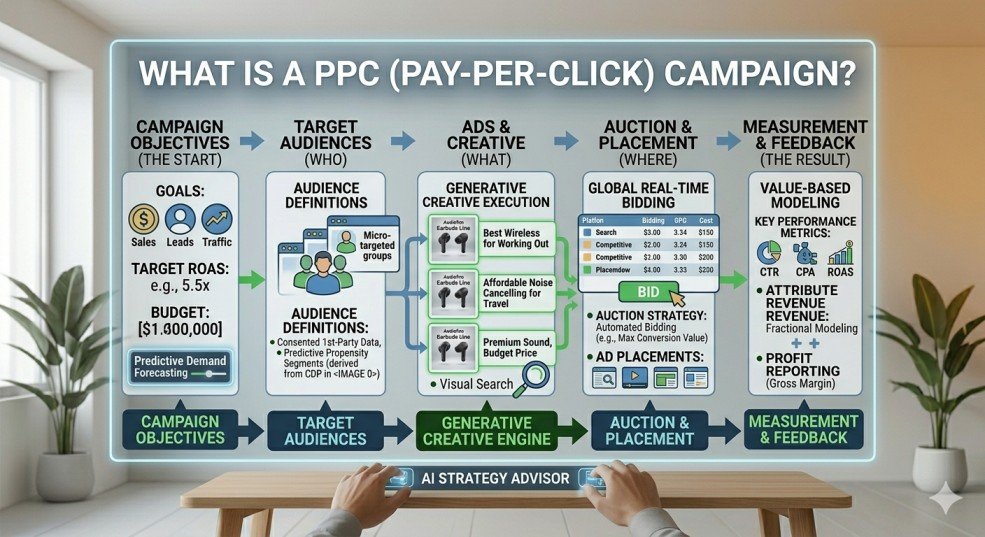
A PPC (Pay-Per-Click) campaign is a digital advertising model where advertisers pay a fee each time someone clicks their ad. It is a way of buying visits to your site rather than earning them organically. The most popular platform is Google Ads, where advertisers bid on keywords to have their ads appear in search results.
In the UAE’s competitive market, PPC has become one of the most efficient ways to get ahead. It provides instant visibility, measurable performance, and precise targeting that traditional marketing cannot match. For businesses looking to maximize their return on investment, professional PPC management services can make the difference between wasted spend and predictable revenue growth.
How Does a PPC Campaign Actually Work?
Understanding the mechanics removes the fear of the unknown. Here is exactly how a PPC campaign works, explained in plain English.
The Ad Auction Explained
Every time someone types a query into Google, an instant auction happens. Google describes this process in detail: “Every time an ad appears, it goes through what we call the ad auction, a process that decides which ads are eligible to appear and in which order” .
This is not like a traditional auction where the highest bidder always wins. Instead, Google uses a system that rewards relevance and quality as much as budget.
How the auction works, step by step :
- A user searches for a keyword, such as “real estate agents in Dubai”
- Google finds all ads whose keywords match that phrase closely enough
- The system removes ads that don’t meet minimum quality standards
- Remaining ads are ordered on the page using Ad Rank
- Ads appear based on this ranking
Key Point: “So even if your competition bids higher than you, you can still win a higher position — at a lower price — with high-quality ads and landing pages” .
Fact Source: Google’s Ad Auction system determines ad placement based on bid amount, ad quality, and user context .
What is Quality Score?
Quality Score is a diagnostic tool from Google that gives you a sense of how well your ad quality compares to other advertisers. It is measured on a scale from 1 to 10 and is available at the keyword level .
Quality Score is calculated based on three components :
| Component | What It Means |
| Expected Click-Through Rate (CTR) | The likelihood that your ad will be clicked when shown |
| Ad Relevance | How closely your ad matches the intent behind a user’s search |
| Landing Page Experience | How relevant and useful your landing page is to people who click your ad |
Trufijo Expert Tip: The secret to lowering your costs is optimising your Quality Score. This means making sure your keywords, ad copy, and landing page are all closely related. Google confirms that “a higher Quality Score means that your ad and landing page are more relevant and useful to someone searching for your keyword” .
Fact Source: Quality Score is calculated based on the combined performance of Expected CTR, Ad Relevance, and Landing Page Experience, evaluated over the last 90 days .
The Anatomy of a Search Ad
A search ad on Google has several key parts. Understanding these components is the first step to creating ads people actually want to click.
- Headlines: The blue, clickable text at the top
- Description: The text below the headline where you explain your offer
- Display URL: The web address shown in the ad
- Final URL: The actual page where the user lands after clicking
- Ad Extensions: Additional information like sitelinks, callouts, and phone numbers
Fact Source: Research shows that ads at the top of the page can capture a significantly higher share of clicks for high-intent keywords .
Where Do PPC Ads Appear?
PPC search ads appear in prominent positions on the Search Engine Results Page (SERP) . They are usually the first results at the very top and the bottom of the page, marked as “Sponsored.”
They are placed “Above the Fold”—the part you see without scrolling—making them highly visible to users actively searching.
Building Your Campaign Structure for Success
A messy, unorganised account is a recipe for wasting money. Here is the blueprint for a successful campaign structure.
The Hierarchy: Account → Campaign → Ad Group → Keywords & Ads
Think of your Google Ads account like a filing cabinet.
- Account: The entire filing cabinet containing all your data
- Campaign: A specific drawer for a major goal or product line
- Ad Group: Folders within the drawer containing a theme of related keywords and the ads that correspond to them
- Keywords & Ads: Individual documents and photos—the specific search terms and ads
Trufijo Insight: A well-structured account helps Google understand your business better, directly improving your Quality Score and lowering your cost-per-click. Expert PPC campaign management ensures your account architecture is built for performance from day one.
Ad Groups: Thematic Clusters
An Ad Group contains a tight group of related keywords and the ads tailored to those keywords.
For a real estate agent, examples would be:
- An Ad Group for “Buyer Leads” with keywords like “homes for sale Dubai”
- A separate Ad Group for “Seller Leads” with keywords like “sell my house fast”
Keywords & Targeting: The Heart of PPC
Your keyword strategy is the foundation of your entire campaign. Getting this right reaches the right people at the right time.
Keyword Match Types
Keywords can be targeted using different “match types,” controlling how closely a user’s search term must match your keyword for your ad to show.
| Match Type | Description |
| Broad Match | Widest net; shows for searches related to your keyword |
| Phrase Match | Shows for searches that include the exact phrase in order |
| Exact Match | Tightest targeting; only shows when the search exactly matches your keyword |
Trufijo Tip: Start your campaign using Exact Match to test which keywords convert. Once you know what works, expand to other match types.
The Secret Weapon: Negative Keywords
Negative Keywords are terms you tell Google not to show your ads for. This is one of the most powerful tools to prevent wasting your budget.
How to find negative keywords: Experts recommend using n-gram analysis—breaking search terms into one, two, or three-word patterns to find wasted spend . By analysing patterns like “and leisure” or “lawn and leisure” appearing across many searches, you can find terms that have generated clicks but zero conversions and add them as negatives .
Key Point: Search Engine Journal notes that “negative keywords remain the most reliable way to prevent ads from serving on competitor-branded queries” . “Adding competitor names as phrase match negatives blocks variations of that brand name, while exact match negatives offer more precision” .
Fact Source: Google and Microsoft Ads restrict the number of negatives an account can include. Most advertisers can expect between 2,500 and 10,000 negatives per account, depending on structure and platform .
Beyond Search: Targeting Options
On Google Ads, you can also target specific audiences:
- Location Targeting: Target specific geographies like Dubai, Abu Dhabi, or a radius around your business
- Device Targeting: Target users on smartphones, desktops, or tablets
- Audience Targeting: Retarget website visitors or target users matching a demographic profile
How Much Does a PPC Campaign Cost in the UAE?
Cost is the primary concern for any beginner. Here is a realistic picture of what a PPC campaign costs in the UAE.
Decoding the Cost Metrics
Understanding the terminology is the first step.
- Cost-Per-Click (CPC): The amount you pay each time someone clicks your ad
- Cost-Per-Acquisition (CPA): The amount you pay to acquire a new customer or lead
- Daily Budget: The average amount you are willing to spend each day on your campaign
What is CPA?
CPA (Cost Per Action or Cost Per Acquisition) is a digital advertising metric that tells you how much you are paying for a specific user action—like a signup, lead, sale, or app install. It focuses on real outcomes .
CPA Formula:
text
CPA = Total Cost ÷ Number of Actions
Example: If you spent $500 on a campaign and received 25 conversions, your CPA is $20 .
Fact Source: CPA is one of the most important performance metrics in digital advertising because it focuses on real outcomes .
UAE CPA Benchmarks
Based on local performance data, here are realistic CPA ranges in the UAE :
| Platform | UAE CPA Range (USD) |
| Meta (Leads) | $5.00 – $10.00 |
| Google Search | $7.00 – $20.00 |
| TikTok | $4.00 – $8.00 |
Industry CPA Benchmarks :
| Industry | Avg. CPA (USD) |
| eCommerce | $4 – $10 |
| Fintech / Lending | $12 – $30 |
| Healthcare | $6 – $15 |
| Education / EdTech | $8 – $20 |
| SaaS / B2B | $20 – $60+ |
Trufijo Insight: In the UAE, CPA is often miscalculated or ignored—especially by businesses focusing too much on impressions or clicks. Brands that understand CPA can track ROI more effectively, optimise their funnel, and scale what actually works .
Fact Source: Google Shopping CPC continues to rise, with an aggregate year-over-year increase of roughly 30% in FY2025 . This pattern shows “commercial visibility now costs more” as competition increases .
Measuring Success: Setting Up Conversion Tracking
If you are not tracking conversions, you are not managing a campaign—you are gambling. This is how you know if your PPC campaign is actually working.
What is a “Conversion”?
A Conversion is any action you want a user to take on your website, such as:
- A purchase
- A form submission
- A phone call
- A newsletter sign-up
How to Set Up Tracking
To track conversions, you need to place a small piece of code, called a Conversion Pixel, on your website. The easiest way to do this is by using Google Tag Manager.
Trufijo Highlight: Proper tracking setup is the most overlooked step. It is the only way to accurately calculate your Return on Investment. Our team ensures every click can be attributed to a tangible result.
PPC vs. SEO: The Dynamic Duo
“Should I use PPC or SEO?” The best answer is both. They work together to create a powerful marketing system.
| Feature | PPC (Paid Search) | SEO (Organic Search) |
| Traffic | Instant | Takes months |
| Cost | Pays for every click | ‘Free’ traffic, costs time/resources |
| Control | High control over messaging | Lower control |
| Trust | Lower trust than organic | Builds long-term authority |
| Data | Provides fast keyword data | Provides long-term insights |
Why You Need Both
PPC data can instantly tell you which keywords are valuable. Use that data to build your SEO content strategy around keywords you know convert. Conversely, SEO builds trust and authority, leading to higher click-through rates on paid ads when people see your brand in both paid and organic results. For businesses targeting specific regions, combining PPC with local SEO services creates a powerful omnichannel approach that captures customers at every stage of their journey.
The 5-Step Checklist to Launch Your First PPC Campaign
You have the knowledge. Now it is time to act. Here is your simple 5-step checklist.
Step 1: Define Your Campaign Goal
Decide if you want to drive sales, generate leads, or build brand awareness.
Step 2: Set a Clear Budget
Start with a small daily budget. In the UAE, a starting monthly budget of AED 3,000 – AED 5,000 is a good test ground.
Step 3: Conduct Keyword Research
Use tools like Google Keyword Planner to find relevant keywords. Look for high-intent keywords.
Step 4: Write Compelling Ads
Write at least 3 different headlines and descriptions. Mention your unique selling point and make your Call-to-Action clear.
Step 5: Install Conversion Tracking
Set up Google Tag Manager and install your conversion tracking pixel. Do not skip this step.
Trufijo Expert Tip: This is non-negotiable. If you are not tracking conversions, you are not managing a PPC campaign; you are gambling with your marketing budget. Professional Google Ads management ensures every aspect of your campaign, including tracking, is handled correctly from day one.
PPC Platforms: Choosing Your Arena
You can run a PPC campaign on many different platforms.
| Platform | Best For |
| Google Ads | Largest platform; essential for high commercial intent searches |
| Microsoft Advertising (Bing) | Less competitive; good for B2B |
| Amazon PPC | E-commerce sellers on Amazon |
| Facebook/Instagram Ads | Brand awareness, demographic targeting, remarketing |
| LinkedIn Ads | Professional B2B services |
Trufijo Insight: Google Shopping ad spend continues to grow, with Performance Max now driving a significant share of that spend .
PPC Campaign Management: DIY vs. Hiring an Expert
Deciding to manage your own campaigns or hire a specialist depends on your budget, time, and experience.
When to DIY (Self-Manage):
- You have a small budget and want to learn
- You have time to dedicate to monitoring and optimisation
- You are starting a simple, targeted campaign
The Role of a PPC Manager
A professional PPC Manager provides:
- Campaign Optimisation: Continuous adjustments to bids, keywords, and ads
- A/B Testing: Testing new ad copy and landing pages
- Performance Monitoring: Tracking KPIs like ROI, CTR, and CPA
- Strategic Guidance: Scaling successful campaigns and exploring opportunities
The Trufijo Advantage: Revenue-Driven Campaigns
Trufijo offers more than standard management. We build a sales system that works for you—managing your entire lead generation and follow-up process so your PPC spend turns into a predictable sales engine. Our PPC management Abu Dhabi service is designed specifically for businesses in the UAE market.
Frequently Asked Questions (FAQ)
Q1: What is the difference between a PPC campaign and a Google Ads campaign?
A: Google Ads is the most popular platform for running PPC campaigns. All Google Ads campaigns are PPC, but not all PPC campaigns are on Google—you can run them on Bing, Facebook, Amazon, and other platforms .
Q2: How long does it take to see results from a PPC campaign in the UAE?
A: Traffic is immediate—ads can go live within hours. However, meaningful results and consistent lead flow usually take 1-3 months, as you need enough data to make informed decisions.
Q3: Why is my cost-per-click (CPC) so high?
A: High CPCs often result from a low Quality Score or high competition for your target keywords. A well-optimised campaign with high relevance can significantly lower your CPC. Google confirms that “even if your competition bids higher than you, you can still win a higher position at a lower price with high-quality ads” .
Q4: How can I avoid wasting money on my PPC campaign?
A:
- Use Negative Keywords to avoid irrelevant searches
- Set a strict daily budget
- Continuously monitor your Search Term Report
- Start with a tight Exact Match keyword strategy
- Make sure your landing page matches your ad copy
Q5: Is PPC good for real estate agents in the UAE?
A: Yes. PPC, especially Google Ads, is highly effective for generating qualified leads. It allows agents to target high-intent keywords and capture buyers and sellers actively searching.
Q6: How much should I budget for my first PPC campaign in the UAE?
A: For a small to medium business, a starting monthly budget of AED 3,000 – AED 5,000 is common to generate enough data for optimisation. UAE CPA benchmarks show Google Search CPA ranges from $7-20 depending on industry .
Your Path to PPC Success
Understanding how a PPC campaign works is the first step. The next is putting that knowledge into action. PPC is a powerful, measurable marketing engine that combines the science of data with the art of persuasive advertising.
Ready to launch a campaign built for revenue, not just clicks?
Book your free consultation with Trufijo today and discover how our revenue-driven sales systems can turn your PPC spend into a predictable sales engine. Our expert team builds and manages the entire system so you can focus on closing deals and growing your business.
